
Boosting productivity in logistics: clear processes with a structured system
The question of how to increase productivity in logistics is the key challenge for many companies across warehousing, dispatch and packaging.
Rising costs, increasing time pressure, a shortage of skilled workers and growing process complexity mean that traditional optimisation measures are often insufficient.
To achieve sustainable productivity improvements, companies should look beyond speed alone and focus on the interaction between processes, workplace design and error prevention.
- Productivity can only be increased if processes, ergonomics and organisation are improved in tandem.
- Even minor bottlenecks such as search times, awkward reach distances or error-prone work steps can significantly reduce productivity in logistics.
- Ergonomic packing tables, digital assistance systems and data-based analyses such as Ergoficiency® help to identify and realise potential for optimisation.
In this article, we set out which factors actually influence productivity in logistics, what typical bottlenecks arise in packaging and dispatch, and what measures can be taken to bring about measurable improvements to processes.
What exactly does 'increasing productivity in logistics' mean?
Increasing productivity in logistics means achieving more consistent performance with existing resources: faster turnaround times, fewer errors, shorter search times, less physical strain and greater process reliability.
It is therefore not simply a matter of getting employees to 'work faster'. It is about designing workplaces, processes and tools more efficiently, so that performance becomes easier, safer and more reproducible.
The following factors have a significant influence on productivity in logistics:
- A well-designed workstation layout reduces unnecessary movements and supports consistent performance in day-to-day logistics operations.
- An optimised material flow shortens travel times and helps to increase productivity in logistics across the entire supply chain.
- Ergonomics improves productivity by reducing physical strain, enabling employees to work consistently for longer periods.
- Standardised workflows increase process reliability, as work steps are carried out uniformly and deviations are identified more quickly.
- Consistent error prevention increases productivity in logistics by reducing rework, returns and customer complaints.
- Training and digital support help employees to carry out even complex logistics processes safely, quickly and with fewer errors.
- Suitable environmental factors such as lighting, noise and temperature directly influence concentration, error rates and productivity in logistics.
Why is it so difficult to increase productivity in logistics sustainably?
The short answer: because many productivity losses remain invisible. Companies often invest in new technology, additional space or revised layouts. Yet the desired effect often fails to materialise. The reason is usually not a lack of will, but a lack of transparency.
Typical obstacles that companies face when seeking to increase productivity in logistics are:
- unnecessary movements
- non-ergonomic reach zones
- redundant actions
- time spent searching
- inconsistent working methods
- media breaks
- incorrect picks and packaging errors
- peaks in physical strain during a shift
Productivity in logistics cannot therefore be reliably increased through individual measures alone. Only once it becomes clear where time is being lost and where physical strain is reducing performance can processes be improved in a targeted manner.
Boosting productivity in logistics: What role does ergonomics play?
Ergonomics is not just an additional consideration, but a driver of productivity. Creating more ergonomically sound workplaces for logistics reduces unnecessary movements, poor posture and fatigue.
This not only improves employees' health, but also boosts speed, quality and consistency.
With Ergoficiency®, Rocholz takes a data-driven approach to identifying strain, movement and environmental factors in packaging and logistics processes.
The anonymised and GDPR-compliant analysis provides an objective basis for specifically identifying the causes of time wastage, errors and fluctuations in performance.
This means that productivity gains in logistics can be not only planned in theory, but also improved in a verifiable way based on real-world processes.
- ● Ergonomics improves productivity in logistics by specifically reducing unnecessary movements and strain-inducing postures.
- ● Ergoficiency makes productivity measurable by systematically analysing movement data, physical strain and the working environment.
Companies can boost productivity in logistics more sustainably by optimising people, technology and organisation in tandem.
How do packing tables help to boost productivity?

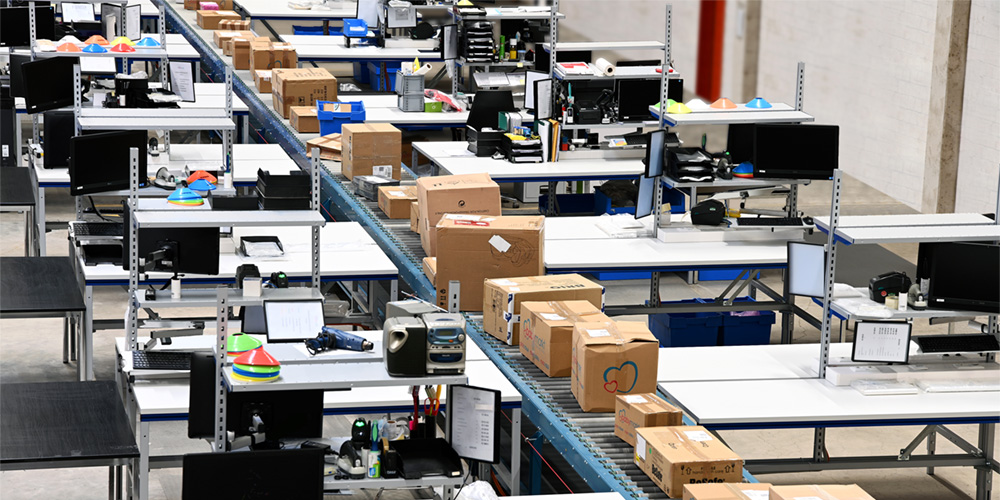
An ergonomically designed packing table increases productivity in logistics by reducing unnecessary movement, repetitive handling and time spent searching for items. At the same time, it reduces the physical strain within the packing process.
Our packing tables are designed with ergonomics, flexibility and process efficiency in mind. The systems can be configured individually, expanded as requirements change and retrofitted on a modular basis:
- Manual or electric height adjustment supports ergonomic working and improves productivity in logistics.
- The integration of roller track tables reduces the need for manual lifting and speeds up the flow of goods at the packing table.
- Suitable lighting solutions improve visibility of products, documents and work steps in the packaging process.
- Monitor and PC mounts keep work surfaces clear and support structured digital workflows in logistics.
- Document storage units and organisation modules reduce search times and increase process reliability for recurring work steps.
- An integrated scale shortens process steps and enables efficient working directly at the packing table.
- The logical arrangement of materials and tools reduces unnecessary movements and helps to optimise processes in the long term.
Start configuring your packing table now
A well-designed packing table reduces walking distances, minimises search times and optimises reach zones. Rocholz points out that, with optimally integrated ergonomic systems, picking and packing performance can be increased by up to 20 %.
How do assistance systems help to increase productivity in logistics?
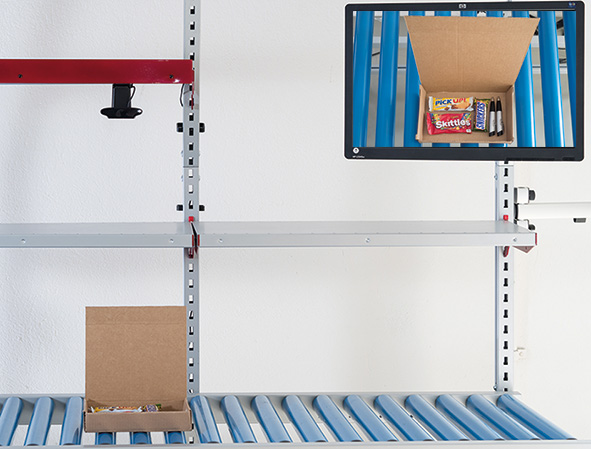
Digital assistance systems are particularly helpful where processes involve many variations, require detailed instructions or are prone to errors.
This is often the case in logistics, dispatch and value-added services. Rocholz offers a range of assistance systems for these purposes.
SimpleAssist supports employees with visual, step-by-step instructions projected directly onto the work surface. The work steps are displayed via a projector, enabling even complex or highly varied tasks to be carried out more easily, with greater clarity and fewer errors. This helps companies to increase productivity in logistics while also simplifying the induction process.
AssisTable is a digital work catalogue for picking and packing processes. Depending on the order, item or destination country, the system shows which work steps need to be carried out and which documents are required. This ensures that standardised processes can be reliably implemented even where there is a high degree of variation.
InspecTable is used for image-based quality control at the workplace. The system compares actual and target states and detects deviations at an early stage, before faulty goods reach the customer. This reduces rework and supports consistent process quality in the dispatch department.
DocumenTable takes photos for documentation directly at the logistics desk in the dispatch or goods-in department. The images are uniquely assigned to a delivery note, order or parcel number and saved with a timestamp. This improves traceability and creates a clear documentation basis for logistics processes.
What specific measures can help to increase productivity in logistics?
For a practical start, companies should consider the following questions:
- Are the reach zones arranged logically and ergonomically?
- Are there any unnecessary movements or time spent searching for items at the packing station?
- Are work instructions clearly displayed for variant processes?
- Are errors detected early on, or only at a later stage?
- Can peaks in workload be identified throughout the day?
- Can the workstation be adapted to different users?
- Do lighting, tidiness and the flow of materials help to maintain concentration?
This gives rise to the following immediate measures:
- The height and layout of the packing table should be suited to the task in order to improve ergonomics and productivity in logistics.
- Providing materials according to frequency of use reduces unnecessary movement and speeds up routine packaging processes.
- Digital assistance systems support complex work steps and help to increase productivity in logistics while reducing errors.
- If quality checks are carried out closer to the workstation, deviations can be identified earlier and more efficiently.
- Automated documentation reduces manual effort and improves traceability in dispatch and goods receipt.
- Real-time process data provides a reliable basis for implementing targeted and traceable productivity improvements in logistics.
This enables productivity to be increased and logistics to be improved step by step.
Boost productivity in logistics: Find the right solution for your facility

Productivity in logistics can be sustainably improved by designing processes to be faster, more accurate and ergonomically sound.
This is precisely where Rocholz's delivers value: our company combines over 100 years' experience in designing workplaces for logistics with ergonomic packing tables, digital assistance systems and the Ergoficiency® analytical approach.
FAQ
How long does it take for productivity improvements in logistics to deliver results?
Initial improvements are often seen in the short term when search times, reaching distances or unnecessary movements are reduced. More significant effects usually arise when workstation design, process standardisation and digital support are optimised together. How quickly results become apparent depends primarily on whether only individual workstations or entire process chains are being optimised.
For companies of what size is it worthwhile to optimise productivity in logistics?
Optimising productivity in logistics is relevant for small, medium-sized and large companies. Even at individual packing stations, inefficient routes, errors or non-ergonomic processes can have a noticeable impact on time, quality and employee deployment. As the size of the team increases, the economic benefits of systematic improvements generally increase as well.
What role does product variety play in logistics productivity?
A high degree of product variety increases the complexity of order picking, packing and dispatch. Different products, customer-specific requirements or country-specific documentation often lead to greater coordination efforts and a higher risk of errors. Clear work instructions and digital assistance help to make this complexity manageable.
How can productivity in logistics be increased without placing an additional burden on employees?
Productivity in logistics does not increase sustainably through greater speed, but through improved conditions within the process. When reach zones are arranged sensibly, distances are shortened and work steps are clearly supported, the physical and mental strain is reduced. It is precisely this that makes higher and, at the same time, more consistent performance possible in the first place.
When should companies seek external support to optimise their logistics processes?
External support is advisable when bottlenecks persist, error rates remain high or internal measures fail to deliver sustained improvements. A structured external perspective is also helpful when the causes are unclear or when decisions need to be made with confidence regarding ergonomics, technology and organisation. Particularly in complex packaging and dispatch processes, this creates a robust basis for setting priorities and making investments.