
Process optimisation in packaging and dispatch with Ergoficiency®
We make stresses visible – for a healthy team
Anyone responsible for packaging and logistics is familiar with the conflicting objectives: processes need to be speeded up and error rates reduced, whilst at the same time demands regarding ergonomics and health and safety are increasing. Furthermore, the shortage of skilled workers is leading to a capacity bottleneck.
Ergoficiency® by Rocholz is an approach that tackles precisely this issue: we combine process optimisation in packaging with an objective data foundation.
Rather than merely describing workflows, we highlight physical strain, movement patterns and environmental factors – in an anonymised, GDPR-compliant manner and with a clear goal: healthy employees and measurably better processes.
- Ergoficiency® by Rocholz is a data-driven approach to process optimisation in packaging and dispatch.
- Anonymised sensor analyses provide an objective and GDPR-compliant insight into movements, physical strain and environmental factors in packaging processes.
- Using Ergoficiency®, Rocholz analyses time wastage, physical strain and critical process steps in day-to-day packaging operations.
- Ergoficiency® can increase process performance by 220 per cent and pay for itself within six months.
Ergoficiency® explained briefly
Ergoficiency® is designed to identify typical bottlenecks in packaging and logistics processes using data.
The key feature is that workload becomes measurable – through an anonymised sensor analysis that provides objective information on:
- Movements (sequences, routes, repetitions, unfavourable patterns)
- Vital signs (stress levels throughout the working day)
- Environment (the impact of light, noise and temperature on concentration and performance)
The aim is not ‘tracking’, but improvement. We create a solid foundation for making workstations more ergonomic, increasing process performance and optimising the packaging process.
In this way, process optimisation in packaging and dispatch becomes a predictable project with Ergoficiency®, rather than a series of individual guesses.



Focus Analysis: Gain rapid clarity on critical ergonomic risks
- 1 employee
- 1 day on site
Package S is suitable if you wish to tackle a specific bottleneck, such as a packing station that is noticeably slow, has an above-average error rate or causes recurring ergonomic problems.
The Focus Analysis provides you not only with a description, but also with a data-driven basis:
- How do movements and workflows actually take place?
- Where do unnecessary steps, detours or problematic patterns arise?
- Which issues can be clearly attributed to process or workplace design?
Output: You will receive a detailed report highlighting the biggest ‘health-killers’ and time-wasters, including practical advice on which improvements promise the quickest results.
Location Analysis: Turning individual observations into a reliable picture of the site
- 4 employees
- Additional results: detailed sketches
The major advantage of Package M is its comparability: you can identify whether stress or time wastage stems primarily from the workplace itself or arises from different working methods, routines and processes.
This provides you with a significantly more robust basis for prioritising measures that not only offer short-term relief but are also effective for the whole team.


System Analysis: If you want a comprehensive ROI, implementation plan and concept
- Up to 8 employees
- 2 days on site
Package L is designed for companies wishing to implement Ergoficiency® as a comprehensive optimisation project.
In addition to the analysis, this package focuses in particular on the following question: Which measures pay off and when – and how can you implement the optimisation in such a way that it functions reliably in day-to-day operations and has a lasting impact?
Additional outcomes:
- We calculate the point at which optimisations to the packaging process become economically viable and when the return on investment is achieved.
- In the 60-minute action workshop, we work with your team to develop concrete solutions for identified strain and process issues.
- You will receive a heat map that visually and clearly illustrates the areas of highest strain and movement within the packaging process.
- In addition, we develop a concept for suitable processes, ergonomic workstations and the necessary hardware.




Security and trust through transparency
Data security & anonymity
- Data collection is carried out in full compliance with the GDPR and meets the applicable data protection standards for the secure handling of sensitive information.
- The anonymised data is not used for the purposes of monitoring behaviour or performance and does not allow any conclusions to be drawn about individual persons.
Acceptance through participation
- Staff are actively involved in the Ergoficiency® process so that practical experiences from day-to-day work can be systematically taken into account.
- The aim of the assessment is openly communicated in order to clearly demonstrate how it promotes health and safety, makes work easier and fosters acceptance within the team.
Scientific basis
- The results of the Ergoficiency® analysis are based on valid measurement data rather than on subjective estimates or individual perceptions.
- The analysis helps to identify health risks in the packaging process at an early stage and to devise targeted preventive measures.

An investment that pays off – +220 % process performance in practice
The background
- Unstructured workflows and time-consuming searches cause avoidable delays in the packaging process and reduce process stability.
- Poorly designed reach distances increase the physical strain on staff and make it difficult to work ergonomically in the dispatch area.
- These stress factors reduce efficiency in day-to-day operations whilst at the same time increasing the physical strain on the team.
The Ergoficiency® solution
- The Ergoficiency® analysis precisely measures actual movement patterns and peak loads in the packaging process, based on objective sensor data.
- Based on the analysis results, the workstation is ergonomically adapted to specifically reduce strain.
- This optimisation helps to avoid unproductive movements and effectively reduce physical strain in day-to-day work.
The result
- In this case study, optimised workflows increased process performance by 220 per cent compared with the original packaging process.
- In this case, the investment of 44,200 euros was fully recouped after six months.
- In the long term, optimised packaging processes can help reduce operating costs while supporting employees’ health and well-being in a lasting way.
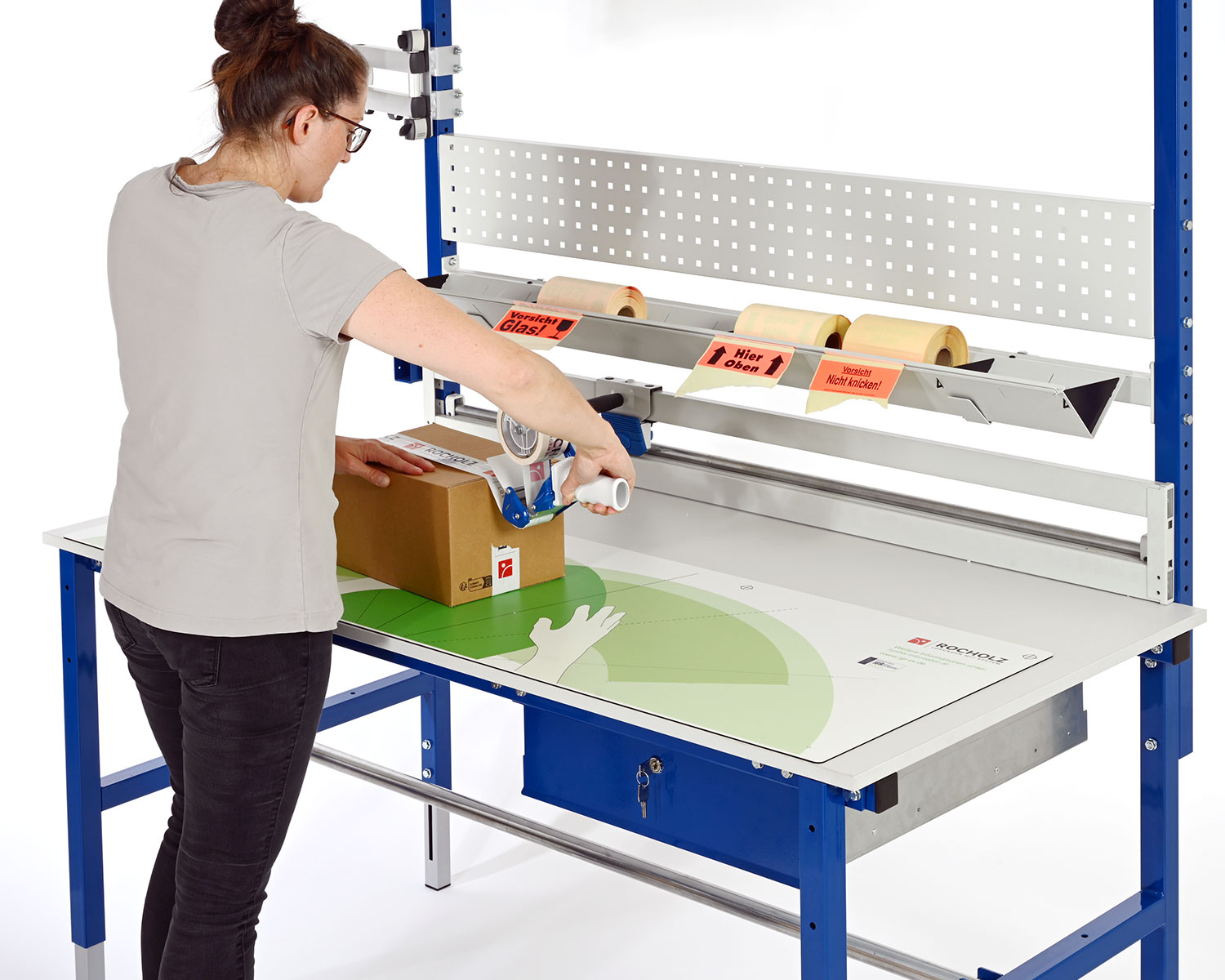
Making packaging processes more efficient with Ergoficiency® by Rocholz
- In an individual consultation, we explore the specific challenges at your site and work together to identify the workstation or process step with the greatest potential for improvement.
- The next step is a no-obligation site visit. We’ll take a look at your operations on site, gain a realistic understanding of your processes, and identify initial areas where we can help reduce your workload and improve efficiency.
- Based on the analysis, we develop a concept tailored to the size of your team, your processes and your specific optimisation objective. This makes it clear which form of Ergoficiency® analysis will deliver the greatest benefit.
Get in touch with us and let’s plan the next steps together to improve ergonomics and ensure stable processes.
Ergoficiency® at a glance:
Download the Ergoficiency® brochure and easily share the key benefits and approaches with your team.
Find out more about ergonomic workplace design here:
FAQ
What is Ergoficiency® by Rocholz – and what is it used for?
Ergoficiency® is a data-driven approach to process optimisation in packaging and dispatch. Anonymised sensor analysis is used to provide insights into movements, vital signs and environmental factors. The aim is to create healthier workplaces and measurably more stable processes.
What data is collected and what is analysed?
The analysis covers movements (e.g. routes, repetitions, unfavourable patterns), vital signs (level of exertion throughout the day) and environmental factors such as light, noise and temperature. The results are grouped into four assessments so that key areas of exertion and opportunities for improvement can be clearly identified.
How does Ergoficiency® ensure data protection and anonymity during data collection?
Ergoficiency® is designed in such a way that data collection is 100 per cent GDPR-compliant and carried out in accordance with applicable data protection standards. The data is completely anonymised and does not allow any conclusions to be drawn about individual persons. In addition, employees are involved in a transparent manner, with a clear focus on health and safety and making work easier.
What is the difference between Packages S, M and L?
Package S is a focused analysis involving 1 member of staff over 1 day and provides a detailed report with quick-win improvement suggestions. Package M involves 4 members of staff and supplements the results with comprehensive sketches to provide a robust picture of the site. Package L involves up to 8 members of staff over 2 days, and also provides ROI recommendations, a workshop, a heat map, and a process and hardware concept.
What financial results can I expect?
A real-world example demonstrates a +220 per cent increase in process efficiency achieved through optimised workflows. The investment of €44,200 was fully recouped after six months. In the long term, the aim is to achieve permanently lower process costs and to protect staff health.
How are the ergonomic scores calculated, and at what point are they considered critical?
Our ergonomic assessment is based on scientifically established evaluation methods as well as relevant norms and ISO standards, such as ISO 9001 and ISO 45001. We incorporate the threshold values defined therein into our assessment accordingly.
We generally distinguish between three categories: Green (non-critical), Yellow (noteworthy or in need of improvement) and Red (critical or requiring action).
The classification is therefore based on defined scientific and normative thresholds, rather than on a subjective assessment.
Which sensors are used?
We use four different measurement systems:
- Process sensors: recording and categorising individual tasks and process steps
- Motion sensors: recording posture, movement patterns and joint angles
- Vital signs sensors: recording the employee’s physiological responses
- Environmental sensors: recording, for example, air quality, temperature, humidity and noise
This enables us to record processes, ergonomics, movement, vital signs and the working environment simultaneously and analyse them together.
How is psychological stress measured, and which factors are taken into account?
Our vital signs sensor includes, amongst other things, an ECG measurement and records various physiological parameters such as heart rate, heart rate variability, respiratory rate, skin temperature and skin resistance.
We thus monitor several physiological indicators of the human body simultaneously. This enables us to assess how the body reacts to different work situations and stress factors.
Combined with feedback from employees via a structured questionnaire, this provides us with a reliable measure of psychological strain or the physiological response to psychological stressors.
In this way, we supplement traditional surveys with objectively measured physical responses to provide a meaningful assessment across various metrics.
What has been your experience regarding reproducibility and repeatability?
For highly repetitive tasks, the results are highly reproducible and representative, as a large number of identical or very similar work sequences can be measured within a short period of time.
For highly individualised tasks, a wide variety of products or significantly different process variants, we recommend our M or L package. This allows for a greater number of situations, product groups and process variants to be taken into account.
This broader data basis is particularly useful if subsequent measures are intended to cover larger areas or multiple product groups.
Which results are derived directly from sensor data, and which are based on the consultants’ interpretation?
The results presented are based on the collected movement, vital signs, environmental and process data, as well as their standardised analysis.
Our aim is to ensure maximum transparency. Anomalies and stress factors are not assessed on the basis of a consultant’s subjective judgement, but rather on the basis of the underlying measurement values. These include, for example, joint angles, movement patterns, heart rate, respiratory rate, environmental values, process times and frequencies.
The recommendations for action are also proposed by our in-house AI based on the collected data and identified correlations. Our consultants then carry out a final expert review to ensure the recommendations are technically sound and plausible.
The consultant’s personal opinion therefore determines neither the assessment nor the recommendations for action. Our approach is deliberately objective, data-driven and transparent. Both the results and the recommendations derived from them can be traced back to the underlying measurement data.
What data do we receive once the analysis is complete?
In total, we record over 100 different measurement parameters as part of an analysis. We process this wide range of individual values in a targeted manner so that it is clear and easy for you to understand where anomalies exist, what causes them, and what specific measures can help.
Our aim is to ensure that the results are fully transparent to you and that you can always see the data on which a recommendation is based.
Personal data is, of course, handled in accordance with the GDPR and is pseudonymised or anonymised.
Would it be possible to split the assessment across two different workstations or tasks?
Yes. Under Package S, we can also assess an employee across two different areas or tasks.
We recommend a minimum of around three hours’ assessment time per area, so that sufficient process and movement repetitions are recorded and we can make a meaningful assessment of the respective potential.
It is important that both areas are assessed on the same day.