
Logistics in e-commerce: driving efficiency with reliable solutions
Info
E-commerce logistics has become one of the most critical components of success for online businesses.
As expectations for fast delivery times and excellent service continue to grow, retailers are under increasing pressure to optimise their processes.
This is where logistics solutions such as packing stations come into play. Thanks to their modular and ergonomic design, they can significantly improve operational efficiency.
This article explores why these adaptations are essential and the benefits they bring to an overall e-commerce strategy.
- Efficient logistics processes are a key success factor in e-commerce, directly influencing delivery times, operating costs and customer satisfaction. Companies with robust processes achieve more reliable deliveries while reducing operational inefficiencies.
- The targeted use of automation and artificial intelligence improves logistics efficiency through more accurate inventory management and optimised route planning. This reduces manual effort while increasing transparency and process reliability throughout the supply chain.
- Sustainable and innovative logistics solutions are becoming increasingly important in e-commerce, combining efficiency gains with changing market requirements. Measures such as resource-efficient processes and quick commerce concepts strengthen the long-term viability of logistics operations.
What is e-commerce logistics and why is it important?
Successful e-commerce logistics relies heavily on structured logistics processes that ensure products reach customers efficiently. These processes have a significant impact on delivery speed, costs and customer satisfaction. Fast delivery times are particularly important for retailers. The challenge lies in managing costs without compromising service quality. Supply chain optimisation is key to achieving this balance.
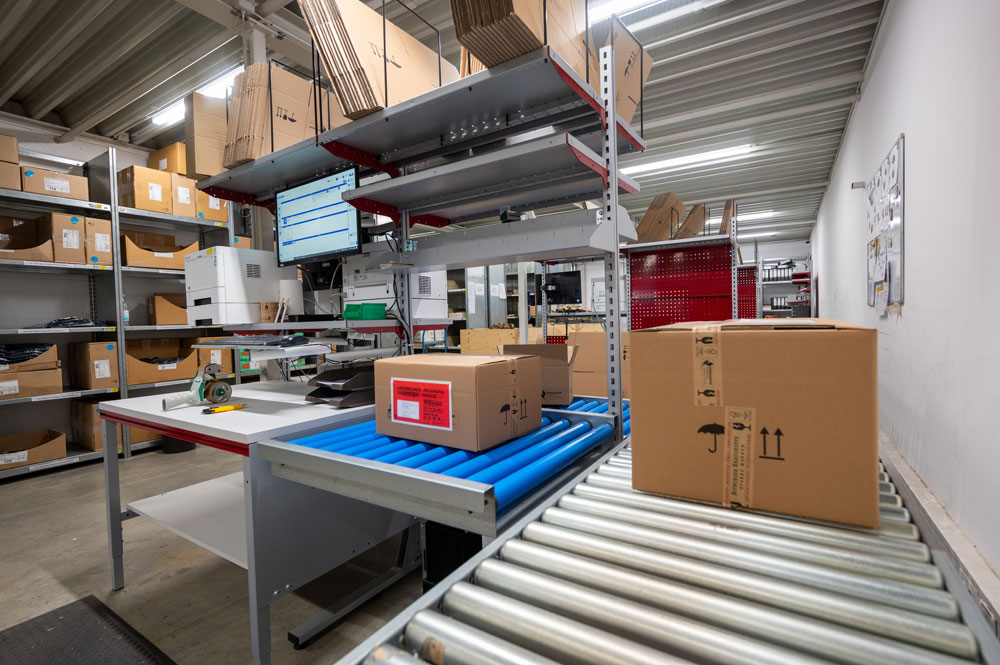
Packing tables offer a wide range of benefits for logistics processes. Thanks to their modular and ergonomic design, they support flexible adaptation within warehouse and shipping environments. These improvements increase efficiency, reduce physical strain, enhance productivity and contribute to higher customer satisfaction.
Benefits of optimised logistics at a glance:
- Faster processing and structured shipping operations reduce delivery times and improve on-time order fulfilment.
- Cost-efficient logistics processes minimise unnecessary expenditure without compromising service quality or operational stability.
- Modular workstations reduce physical strain and support more ergonomic working conditions for employees.
- A high degree of flexibility enables rapid adaptation to seasonal fluctuations, changing order volumes, product ranges and operational requirements.
How do delivery times affect customer satisfaction in e-commerce?
Delivery times have a direct impact on customer satisfaction because they shape perceptions of service quality and reliability.
According to IFH Köln, the majority of consumers expect delivery within two days, while 84% consider delivery on the promised date to be particularly important.
At the same time, the EHI Retail Institute reports that 61% of retailers offer delivery within one to two working days.
For online retailers, this clearly demonstrates that fast and reliably communicated delivery processes are essential for meeting customer expectations and maintaining competitiveness.
Same-day delivery still plays a relatively minor role, while efficient logistics operations and ergonomically designed packing processes form the foundation for short and dependable delivery times.
How can shipping costs improve the business model?
Shipping costs are a major cost factor in e-commerce logistics. A well-planned shipping cost strategy can significantly increase the profitability of a business model.
Retailers often offer free shipping above a certain order value in order to increase order volumes and customer satisfaction. However, this approach requires careful cost management to remain profitable. Many retailers therefore work with multiple shipping providers. This reduces costs while increasing flexibility when selecting the most suitable carrier.
By strategically combining different delivery service providers, retailers can optimise their logistics operations and remain competitive. Choosing the right logistics partner becomes a critical success factor.
- Free shipping above a specified order value can significantly increase order volumes and customer satisfaction.
- Working with multiple carriers enables flexible and cost-effective delivery options.
- An optimised cost structure improves customer service and strengthens competitiveness.
What are the challenges of returns management in e-commerce?
Returns management presents financial, environmental and operational challenges for e-commerce businesses, as returned goods create additional inspection, storage and transport requirements. A key consideration is how returns can be organised in a way that minimises processing times, costs and quality losses during day-to-day operations.
Additional effort is required whenever returned goods need to be inspected, repackaged, refurbished or returned to stock.
At the same time, damaged packaging, missing original materials and inconsistent processes can make cost-effective reprocessing more difficult within warehouse and shipping operations.
Effective returns management therefore combines return prevention measures with efficient internal processes.
What role do technology and automation play in e-commerce logistics?
Technology is crucial for achieving shorter delivery times and greater efficiency. Automated warehouse processes are indispensable for retailers.
Artificial intelligence (AI), in particular, introduces a new level of capability to inventory tracking and route planning. These systems dramatically improve the accuracy and speed of logistics operations.
- Automated systems support logistics processes by standardising repetitive tasks and improving operational reliability.
- Artificial intelligence enhances inventory management by enabling more precise stock control and more effective resource allocation.
- AI-powered route planning reduces delays during transport and helps companies manage logistics costs more effectively.
Modular workstations also play a key role in e-commerce logistics. They not only increase flexibility and adaptability in the workplace but also support employee wellbeing, contributing to greater efficiency overall.
Use of packing tables and assistance systems
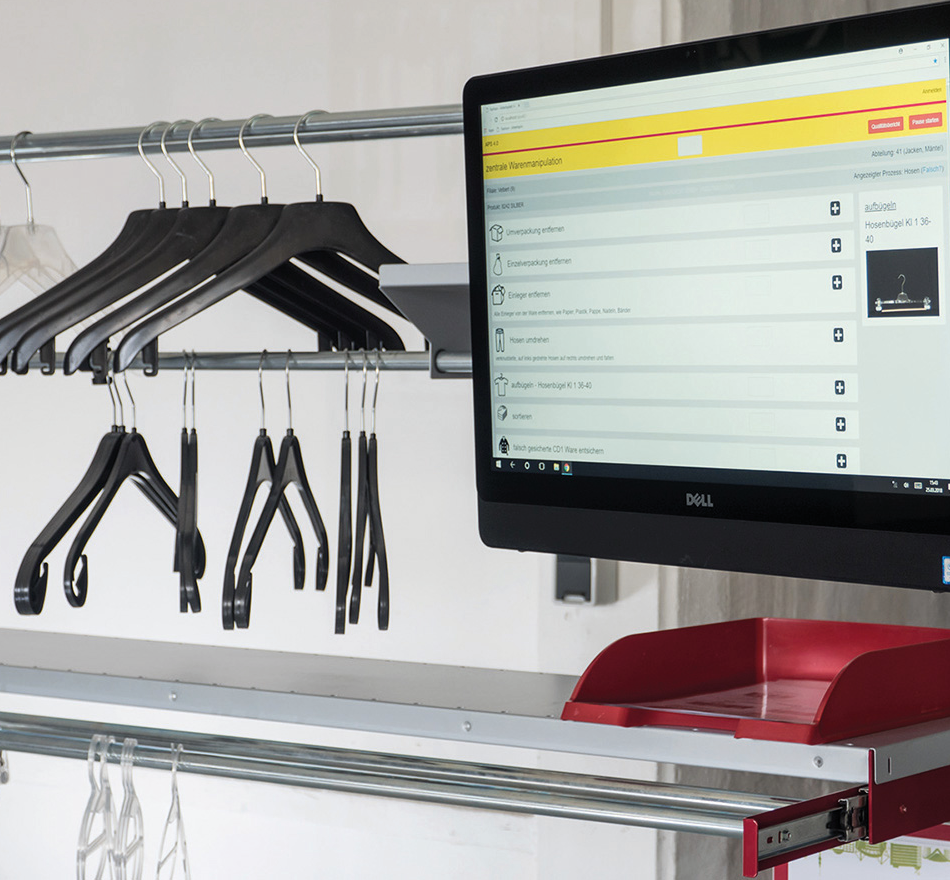
While packing stations provide the ergonomic and functional foundation of the workplace, assistance systems deliver visual guidance, process assurance and documentation.
SimpleAssist is a stand-alone assistance system featuring a height-adjustable packing station and projection technology. It projects work instructions directly onto the work surface, enabling an accessible, visually guided workflow.
AssisTable extends this approach as a digital work catalogue for picking and packing processes. Depending on the order, the system displays the required work steps, packaging specifications and relevant documentation.
Additional assistance systems support quality assurance and traceability. InspecTable uses image-based inspection to identify deviations from predefined standards, while DocumenTable photographs package contents directly at the packing station and links them to the corresponding process.
This becomes increasingly important as product variety, quality requirements and efficiency pressures continue to grow.
Making e-commerce logistics more efficient
Rocholz supports companies in designing packaging and logistics workstations where efficiency, ergonomics and process reliability work together.
Talk to our experts and discover the right solution for your shipping, warehousing and returns management requirements.
FAQ
Which key performance indicators are most important in e-commerce logistics?
Key performance indicators in e-commerce logistics include processing time, delivery rate, error rate, returns rate and shipping costs per order. These figures help to identify weaknesses in the warehousing and dispatch processes at an early stage and to systematically prioritise areas for optimisation.
When is it worth switching to modular logistics workstations?
Modular logistics workstations are particularly beneficial when product ranges, order volumes or process requirements change regularly. They simplify adaptations during ongoing operations and allow workplaces to evolve without requiring a complete redesign.
How can errors in the packaging process be reduced in the long term?
Packaging errors can be reduced through clearly defined work steps, organised material provision and well-structured workstations. Visual assistance systems provide additional support when processes become more complex or involve multiple product variants.
What role does ergonomics play in e-commerce logistics?
Ergonomics is important in e-commerce logistics because physically demanding work processes affect productivity, process quality and the long-term fitness for work of staff. Ergonomically designed workstations can help to reduce awkward movements and organise work processes more efficiently.
How can companies scale up their logistics processes without compromising on process quality?
Logistics processes can be scaled more effectively if workflows are standardised, workstations are set up flexibly and process steps are clearly documented. This creates a robust foundation for handling growing order volumes without unnecessarily increasing error rates or the effort required for coordination.