Shaping work for people with disabilities
Info
What does work mean for people with disabilities?
Work for people with disabilities refers to occupational activities that are designed to take account of physical, mental or psychological limitations and enable participation in working life.
It is a key component of an inclusive society because it promotes self-efficacy, social integration and economic independence.
An inclusive workplace means that everyone, regardless of physical or mental limitations, has the opportunity to use their skills productively.
For this to succeed, suitable working environments are needed that combine safety, ergonomics and adaptability.
- Ergonomic workstations for accessible working
- Customisable packing and workbenches
- Efficient process support through technical assistance systems
- Sustainable solutions for inclusive businesses
Designing workstations for people with disabilities requires careful planning and an understanding of ergonomic principles. In workshops and logistics centres in particular, height-adjustable packing tables and modular workstations can significantly enhance employees’ independence.
An ergonomic workstation is designed to adapt to the user – not the other way round.
What legal frameworks and inclusion initiatives are in place?
Legislation and funding opportunities (e.g. from the Job Centre) are essential for the integration of people with disabilities. The UN Convention on the Rights of Persons with Disabilities makes it clear that the inclusion of people with disabilities in all areas of life is a human right.
There are numerous schemes and financial incentives designed to make it more attractive for businesses to recruit, employ and support people with disabilities.
Examples of this include financial support from integration offices, wage subsidies and assistance with adapting workplaces to meet the needs of people with disabilities. These measures help companies to employ people with disabilities and provide them with an optimal working environment.
Joint initiative to promote inclusion
One example of a successful inclusion initiative is the ‘Joint Initiative to Strengthen Inclusion in the Labour Market of North Rhine-Westphalia’. This was launched by various partners, including the state government, employer representatives and the Federal Employment Agency.
Ziel ist es, Menschen mit Behinderung und Arbeitgeber mit offenen Stellen besser zusammenzubringen. Durch geThe aim is to better connect people with disabilities with employers who have vacancies. Through joint efforts and targeted measures, the potential of people with disabilities is to be better utilised.
How can inclusive workplaces be created?
An inclusive workplace takes into account physical, sensory and mental health needs. This applies both to people with physical disabilities and to those with mental health or intellectual disabilities.
Flexible workspaces provide the necessary support to boost individual productivity and prevent health problems.
Workplace ergonomics as a foundation
Ergonomics refers to the process of adapting working conditions to people’s needs. Height-adjustable desks, optimally positioned materials and customisable work surfaces create a healthy and productive environment.
According to a study by the Federal Institute for Occupational Safety and Health (BAuA, 2023), ergonomically designed workstations can reduce sick leave by up to 25%.
Find out more about ergonomic working now
What technical aids support accessible working?
Digital assistance systems, such as visual work instructions, integrable scales and scanners, improve usability and reduce the risk of errors.
This makes employment more accessible for people with mental or intellectual disabilities. For businesses, this means increased efficiency whilst fulfilling their social responsibilities.
Ergonomic solutions from Rocholz
Rocholz offers a range of ergonomic and accessible workplace solutions that are specifically tailored to the needs of people with disabilities. These include our assistance systems:
SimpleAssist – Visual guidance for error-free, ergonomic working
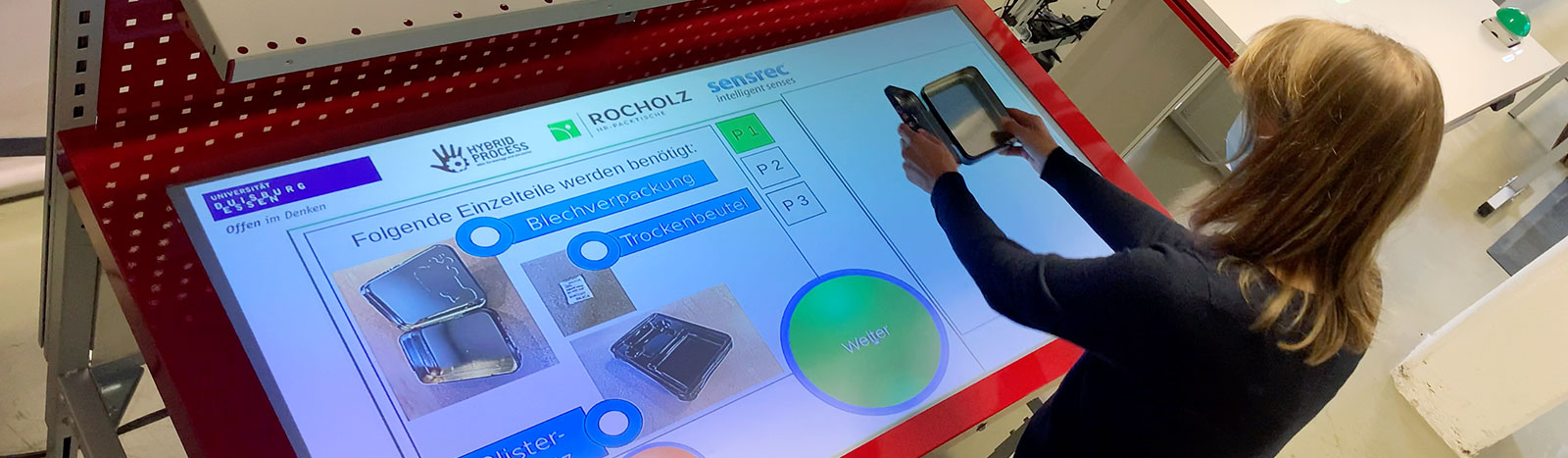
SimpleAssist makes day-to-day work easier by providing visual instructions. It consists of a projector and two buttons. A projector displays the steps directly on the work surface, helping to prevent mistakes.
AssisTable: Digital work catalogue for order picking and packing
The AssisTable is a digital work catalogue designed to assist with order picking and packing processes. Depending on the supplier, destination country and specific product characteristics, the system displays how items should be packed and handled. This makes the work easier and ensures greater efficiency.
InspecTable: Visual quality control using machine learning
InspecTable enables visual quality control using machine learning. The system can detect deviations and defects at an early stage, thereby ensuring the high quality of the goods produced. It is flexible and can be easily adapted to a variety of applications for the work of people with disabilities.
DocumenTable: Photo documentation directly at the logistics desk
With DocumenTable, photos can be taken directly at the logistics desk for documentation purposes. The images are automatically tagged with the delivery note number and a timestamp, which makes them easier to trace and helps ensure quality in the work carried out by people with disabilities.
Why are work and participation so important?
Employment for people with disabilities is important both for society and for the individuals concerned. It promotes independence, boosts self-esteem and facilitates social integration.
It plays a key role, particularly in workshops and inclusive workplaces, in maintaining productivity and fostering a sense of equality.
- Promoting self-employment through tailored working conditions
- Equal opportunities in production, logistics and administration
- Social inclusion in working life
Work for people with disabilities is key to inclusion – it builds self-confidence, provides structure and brings social recognition.
How can individual customisation be achieved?
Every disability requires different working conditions. Packing tables that are height adjustable, either mechanically or electronically, make work easier for wheelchair users, for example.
Customisable components such as brackets, bottom shelves and audible alarms complete the range of features and ensure safety and comfort.
How does workplace design work in practice?
The design of workstations for people with disabilities follows a structured process. The aim is to optimally combine movement patterns, cognitive demands and technical support.
The choice of suitable materials and height-adjustable systems plays a crucial role in this.
What steps are involved in the analysis and adaptation?
The first step is an ergonomic workstation analysis. This is followed by customisation using modular components that keep tools and packaging materials within easy reach.
By combining these components in the right way, efficiency is increased and physical strain is minimised.
Further information on the legal basis can be found in the article
„Ergonomics in the workplace: What guidelines are there?“.
Different working arrangements and facilities
Workshop for people with disabilities (WfbM)
Workshops for people with disabilities (WfbM) provide a supported working environment in which people with disabilities can take on a wide range of tasks. These workshops specialise in providing jobs that are tailored to the skills and needs of the employees.
Funding bodies
Support centres are aimed at people with severe intellectual or multiple disabilities who are unable to work in a sheltered workshop. These facilities provide structured day care and support personal development and participation in social life.
Working in the open labour market
For many people with disabilities, the goal is to secure a job in the open labour market. With the right support and adjustments, people with disabilities can work successfully in mainstream companies.
Integration support workers and specialised training programmes prepare those affected for this challenge.
Conclusion: Thinking about work and inclusion together
Employment for people with disabilities is more than just a social objective – it is an integral part of the modern workplace.
With the right ergonomic and technical solutions, barriers are removed and the quality of work is improved. Workstations tailored to individual needs empower staff and improve processes throughout the organisation.
Why is Rocholz the right partner for inclusive workplaces?
Rocholz GmbH has been developing ergonomic packing table systems and customisable workstation solutions for over 100 years.
As an experienced partner to industry and social institutions, Rocholz helps companies to design workplaces that are both efficient and accessible.
- Extensive expertise in the development of ergonomic workstation systems
- Sustainable solutions for workshops and inclusive businesses
- Practical advice with a focus on efficiency and safety
Rocholz combines over 100 years of experience with modern assistive technology – creating workplaces that empower people.

Expert in strategic corporate development and the future of intralogistics
connect on LinkedIn