Logistics in e-commerce: efficiency through robust solutions
Info
Logistics in e-commerce has become one of the most crucial factors in the success of online businesses.
With growing expectations for fast delivery times and high service quality, retailers face the challenge of continuously optimising their processes.
This is where logistics solutions such as packing tables come into play. Thanks to their modular and ergonomic design, they offer a significant increase in efficiency.
This article examines why these adjustments are essential and what benefits they bring to the overall e-commerce strategy.
- Efficient logistics processes are a key success factor in e-commerce, as they have a direct impact on delivery times, process costs and customer satisfaction. Companies with stable processes ensure more reliable deliveries while reducing operational inefficiencies.
- The targeted use of automation and artificial intelligence improves efficiency in logistics through more accurate inventory management and optimised route planning. This reduces the amount of manual work required, whilst increasing transparency and process reliability within the supply chain.
- Sustainable and innovative logistics solutions are becoming increasingly important in e-commerce, as they combine efficiency gains with evolving market requirements. Measures such as resource-efficient processes and quick-commerce concepts strengthen the future viability of logistics structures.
What is logistics in e-commerce, and why is it important?
Successful e-commerce logistics depends largely on well-structured logistics processes that deliver products to customers efficiently.
These processes have a significant impact on delivery speed, costs and customer satisfaction. Fast delivery times are crucial for retailers.
The challenge lies in managing costs without compromising service quality. Optimising the supply chain is key here.
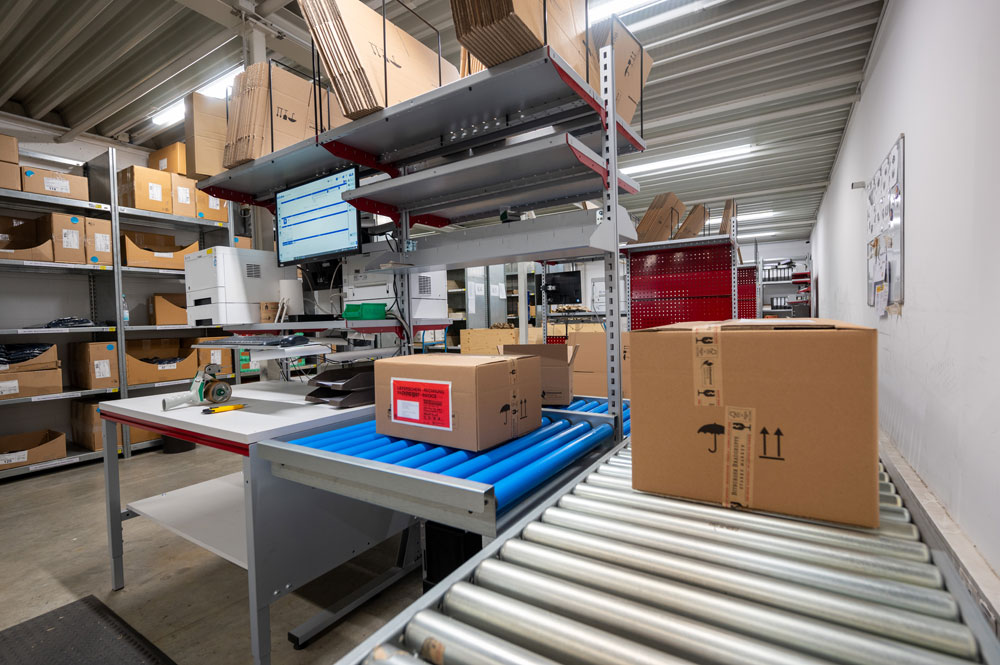
Packing tables offer a wide range of benefits for logistics processes. Thanks to their modular and ergonomic design, they enable flexible adaptations in the warehouse and dispatch areas. These adaptations contribute to efficiency and a reduction in workloads, boost productivity and enhance customer satisfaction.
Key benefits of optimised logistics at a glance:
- Faster processing and well-structured dispatch workflows reduce delivery times in e-commerce and improve on-time order fulfilment.
- Cost-effective logistics processes reduce unnecessary expenditure without compromising service quality or process stability in the dispatch department.
- Modular workstations reduce physical strain in logistics and support ergonomic, less strenuous workflows for employees.
- High flexibility in logistics enables businesses to respond quickly to seasonal fluctuations, changes in order volumes, product ranges and process requirements.
How do delivery times affect customer satisfaction in e-commerce?
Delivery times have a direct impact on customer satisfaction in e-commerce, as they shape perceptions of service quality and reliability.
According to the IFH KÖLN, the majority of consumers expect delivery within two days, while 84 % consider on-time delivery on the promised date to be particularly important.
At the same time, the EHI Retail Institute shows that 61 % of retailers offer delivery within one to two working days.
For online shops, this highlights the fact that fast delivery processes, combined with reliable communication, are a key factor in meeting customer expectations and maintaining competitiveness.
Same-day delivery currently plays only a minor role, whereas efficient logistics operations and ergonomically designed packing processes provide the foundation for short and reliable delivery times.
How do shipping costs optimise the business model?
Shipping costs are a key cost factor in e-commerce logistics. Effective shipping cost optimisation can significantly improve the profitability of business models.
Retailers often offer free delivery above a certain order value to increase order volumes and enhance customer satisfaction. However, this strategy requires careful cost management to ensure profitability is maintained.
Many retailers rely on multiple delivery providers for this purpose. This approach reduces costs while simultaneously increasing flexibility in choosing the right provider.
By strategically combining different delivery providers, retailers optimise their logistics and remain competitive. Choosing the right logistics partner thus becomes a crucial success factor.
- Free delivery above a certain order value significantly increases order volumes and customer satisfaction.
- Using multiple delivery providers enables flexible and cost-effective delivery options.
- An optimised cost structure improves customer service and strengthens competitiveness.
What are the challenges of returns management in e-commerce?
Returns management in e-commerce presents retailers with financial, environmental and operational challenges, as returned goods generate additional costs for inspection, storage and transport.
A particularly important question is how returns can be organised in such a way that processing times, costs and quality losses are kept to a minimum during day-to-day operations.
Additional effort is required whenever returned goods need to be inspected, repackaged, refurbished or returned to stock.
At the same time, damaged packaging, missing original materials or inconsistent procedures make it difficult to process items cost-effectively during the dispatch and warehousing process.
Effective returns management therefore combines the prevention of returns with efficient internal processes.
What role do technology and automation play in e-commerce logistics?
Technology is crucial for achieving shorter delivery times and greater efficiency. Automated warehouse processes are indispensable for retailers.
Artificial intelligence (AI), in particular, brings a new dimension to stock tracking and route planning. These systems drastically increase the precision and speed of operations.
- Automated systems support logistics processes by standardising repetitive procedures and enabling businesses to manage operational demands more efficiently and reliably.
- Artificial intelligence enhances inventory tracking by providing greater stock visibility and enabling resources to be allocated more effectively according to demand.
- AI-supported route planning reduces time lost in transport and helps companies manage logistics costs more effectively.
Modular workstations play a key role in e-commerce logistics. These systems not only increase flexibility and adaptability in the working environment, but also support employees' back health, which ultimately helps to boost efficiency.
Use of packing tables and assistance systems
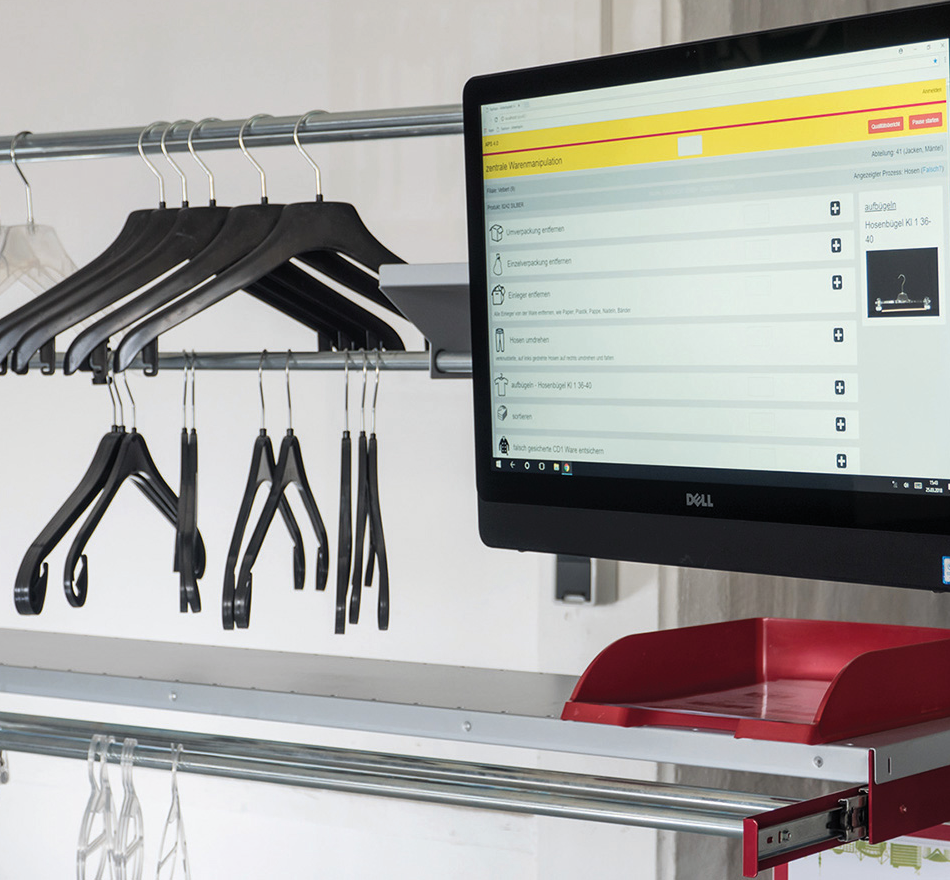
Packing tables and digital assistance systems support warehousing and dispatch processes by structuring work steps, reducing sources of error and better standardising procedures to meet different requirements.
While packing tables provide the ergonomic and functional foundation in the workplace, assistance systems handle visual guidance, process monitoring and documentation.
SimpleAssist is a stand-alone assistance system featuring a height-adjustable packing table and a projection system that displays work steps directly onto the work surface, supporting an intuitive, visually guided and accessible workflow.
AssisTable complements this approach as a digital work catalogue for order-picking and packing processes, with the system displaying the required work steps, packing specifications and documents depending on the order.
Further assistance systems are used for quality control and traceability. InspecTable uses image-based checks to verify whether items, line items or pack images deviate from the defined target state, while DocumenTable photographically documents parcel contents directly at the logistics table and uniquely assigns them to a specific process.
Assistance systems in logistics therefore serve not only to automate processes, but above all to ensure that they are standardised, traceable and ergonomically supported.
This is particularly relevant when the variety of product variants, quality requirements and pressure to improve efficiency in the dispatch process are all increasing at the same time.
Making e-commerce logistics more efficient
Rocholz supports businesses design packaging and logistics workstations where efficiency, ergonomics and process reliability work hand in hand.
Contact us for expert advice and discover the right solution for your requirements in dispatch, warehousing and returns processing.
FAQ
Which key performance indicators are particularly important in e-commerce logistics?
Key performance indicators in e-commerce logistics include order processing time, delivery performance, error rate, returns rate and shipping costs per order. These figures help to identify weaknesses in the warehousing and dispatch process at an early stage and to systematically prioritise opportunities for optimisation.
When are modular logistics workstations worth implementing?
Modular logistics workstations are particularly beneficial when product ranges, order volumes or process requirements change regularly. They make it easier to make adjustments while operations are ongoing and help companies adapt workstations to new processes without having to completely redesign them.
How can errors in the packaging process be reduced in the long term?
Errors in the packaging process can be reduced primarily through clear work steps, organised material provision and well-structured workstations. Visual assistance systems offer additional support when processes become more complex or when different variants need to be handled reliably.
What role does ergonomics play in e-commerce logistics?
Ergonomics is highly relevant in e-commerce logistics because physically demanding tasks affect productivity, process quality and the long-term wellbeing of employees. Ergonomically designed workstations help to reduce awkward movements and organise work processes more efficiently.
How can companies scale up their logistics processes without compromising process quality?
Logistics processes can be scaled up more effectively if workflows are standardised, workstations are set up flexibly and process steps are clearly documented. This creates a robust foundation for handling growing order volumes without unnecessarily increasing error rates or the effort required for coordination.