

Logistics process optimisation: how to improve efficiency
In today's fast-paced business world, logistics process optimisation is the key to success. Efficient processes not only reduce costs but also increase the reliability of deliveries, which is crucial in a highly competitive market.
The use of ergonomic packing tables and digital assistance systems, in particular, helps to systematically improve warehousing and dispatch processes.
These adjustments ensure that companies not only remain competitive but can also strengthen their position as industry leaders. In this article, you will learn how process optimisation can make your logistics operations more efficient.
- Logistics process optimisation enables targeted improvements to warehouse and transport operations. This reduces costs and sustainably increases delivery performance.
- Modern methods such as process costing, simulations and digital analyses highlight weaknesses in logistics processes. This enables companies to devise well-founded measures to improve efficiency.
- Ergonomic packing tables and digital assistance systems improve the provision of materials and support structured workflows in dispatch. At the same time, they promote ergonomic workplace design and reduce physical strain.
What is logistics process optimisation?
Logistics process optimisation aims to improve the flow of materials and information in order to reduce costs and increase the reliability of deliveries.
The focus is on both warehouse and transport processes, as well as comprehensive planning processes across the entire supply chain. These optimisations help to strengthen long-term competitiveness.
A key factor is the improvement of warehousing and transport processes, which not only drastically reduces costs but also ensures on-time delivery performance. Structured workflows and optimised material handling significantly increase delivery reliability.
Why is process analysis crucial in logistics?
Process analyses are essential for ensuring efficient logistics operations. Clearly defining objectives at the outset enables targeted improvements. Key methods such as the current state analysis and process modelling help to gain a comprehensive understanding the entire workflow.
The process involves interviews, observations and data analysis, which provide deeper insights. A precise analysis of weak points enables specific shortcomings to be identified and rectified.
The result is a well-defined target state that optimises processes. Modern systems such as Ergoficiency® use sensor-based technologies to create workplaces that are both efficient and ergonomic. This combination ensures lasting operational optimisation.
Approaches to process analysis
Structured approaches such as activity-based costing are essential for designing efficient logistics processes. They systematically record all cost drivers and thereby provide a reliable basis for decision-making.
Simulations offer the opportunity to test different process scenarios in advance and to identify and eliminate bottlenecks before they occur. This results in optimised lead times.
The use of measurement systems is crucial for defining relevant performance indicators. These indicators provide the foundation for regularly assessing process efficiency.
Benchmarking -- the comparison with industry standards -- offers clear guidance for improvement and enables the development of tailored optimisation measures.
- Process costing highlights which logistics processes generate particularly high costs and where targeted optimisations would be beneficial.
- Simulations help to test logistics processes realistically before implementing changes and to identify potential bottlenecks at an early stage.
- Measurement systems define relevant key performance indicators that can be used to objectively assess the performance and efficiency of logistics processes.
- Benchmarking compares logistics processes with industry standards and clearly highlights specific opportunities for improvement.
Which key performance indicators are crucial for logistics process optimisation?
Key performance indicators are essential for successful logistics process optimisation. First and foremost is lead time; reducing this has a direct impact on on-time delivery performance and improves the ability to respond quickly to market demands.
- High on-time delivery rates improve customer satisfaction and reduce delays in downstream logistics processes.
- Low transport costs are achieved through efficient route planning, better utilisation of capacity and the targeted consolidation of shipments.
- A high inventory turnover rate and an appropriate stock range reduce capital tied up in inventory and improve the utilisation of existing warehouse capacity.
These key performance indicators make logistics optimisation measurable and enable sustainable performance improvements.
Methods for optimising logistics processes
The standardisation of workflows is a key objective of logistics process optimisation. Continuous improvement processes (CIP) are crucial for minimising errors and increasing efficiency. New technologies make this process significantly easier.
Total Quality Management enables quality and efficiency to be systematically improved. This method relies on consistent quality controls and improvement measures.
Applying this approach ensures that the bigger picture is kept in mind and that opportunities for optimisation are identified at an early stage.
A detailed workflow analysis provides insight into existing structures. This method identifies bottlenecks and thus gradually improves processes. An effective workflow analysis can improve efficiency enormously.
What challenges make logistics process optimisation difficult?
In practice, logistics process optimisation often fails not because of individual measures, but due to a lack of transparency in day-to-day operations.
If work steps, information flows and responsibilities are not properly aligned, this leads to errors, delays and unnecessary additional work.
Particularly in warehousing, dispatch and order picking, product variety, quality requirements and documentation obligations are constantly increasing.
Consequently, the demands for standardised procedures, clear work instructions and reliable recording of relevant process data are rising.
Another obstacle is the use of isolated systems and manual intermediate steps, which cause data discontinuities and make traceability more difficult.
Without reliable data on process times, causes of errors or capacity utilisation, logistics operations can only be assessed and improved to a limited extent.
Effective logistics optimisation therefore requires solutions that provide structured support for day-to-day processes, highlight sources of error and make information available directly at the workplace. This is precisely where digital assistance systems and ergonomically designed workstations come into play.
How do digital assistance systems affect logistics?
Digital assistance systems improve logistics processes by supporting employees with picking, packing, checking and documentation tasks directly within the workflow.
They help to reduce errors, standardise work steps and ensure that even complex or highly variable processes can be carried out in a traceable manner.
Rocholz's assistance systems are designed to meet typical requirements in warehousing, dispatch and goods receipt.
These include visual step-by-step instructions at the workstation, digital work catalogues for picking and packing processes, image-based quality checks, and photo-supported documentation of parcel contents and shipments.
One example is SimpleAssist, a projection-based assistance system that displays individual work steps directly on the work surface, making them visible at the packing station.
AssisTable supports employees with digital work instructions for processes involving a wide variety of options and can simultaneously record performance data.
InspecTable uses image-based checks and machine learning to detect deviations and errors at an early stage.
DocumenTable documents packing or goods-in processes with photos, timestamps and clear links to documents or orders.
For logistics process optimisation, such systems are particularly relevant where quality assurance, traceability, standardised workflows and low error rates are required.
Digital assistance systems thus create a robust foundation for making logistics processes more efficient, transparent and stable.
What advantages do ergonomic packing tables offer in terms of logistics process optimisation?
Ergonomic and modularly adaptable packing tables support logistics process optimisation by improving material supply, reach zones and workflows in the warehouse and dispatch areas.
They help to make packing and order-picking processes more structured, safer and more efficient. A key advantage is the ergonomic workstation design.
When working heights, reach zones and layouts are tailored to the specific task, physical strain can be reduced and manual processes carried out more efficiently.
Thanks to their modular design, the packing tables can be adapted to different warehouse layouts and process requirements.
This enables companies to optimise existing logistics workstations without having to completely reorganise their processes.
Ergonomic packing tables thus combine workplace design with process requirements. They help to improve productivity, process quality, workplace safety and employee health at the same time.
Key benefits of ergonomic packing tables in logistics
- Ergonomic packing tables reduce physical strain, as working heights, reach zones and work equipment can be adapted to the individual employee requirements.
- A structured system for supplying materials at the packing table shortens walking distances and supports smooth processes in dispatch and order picking.
- Modular packing tables can be adapted to different warehouse layouts make it easier to integrate optimised workstations into existing logistics processes.
- Ergonomically designed workstations improve process quality, health and safety, and employee satisfaction in day-to-day logistics operations.
Targeted improvements to logistics processes
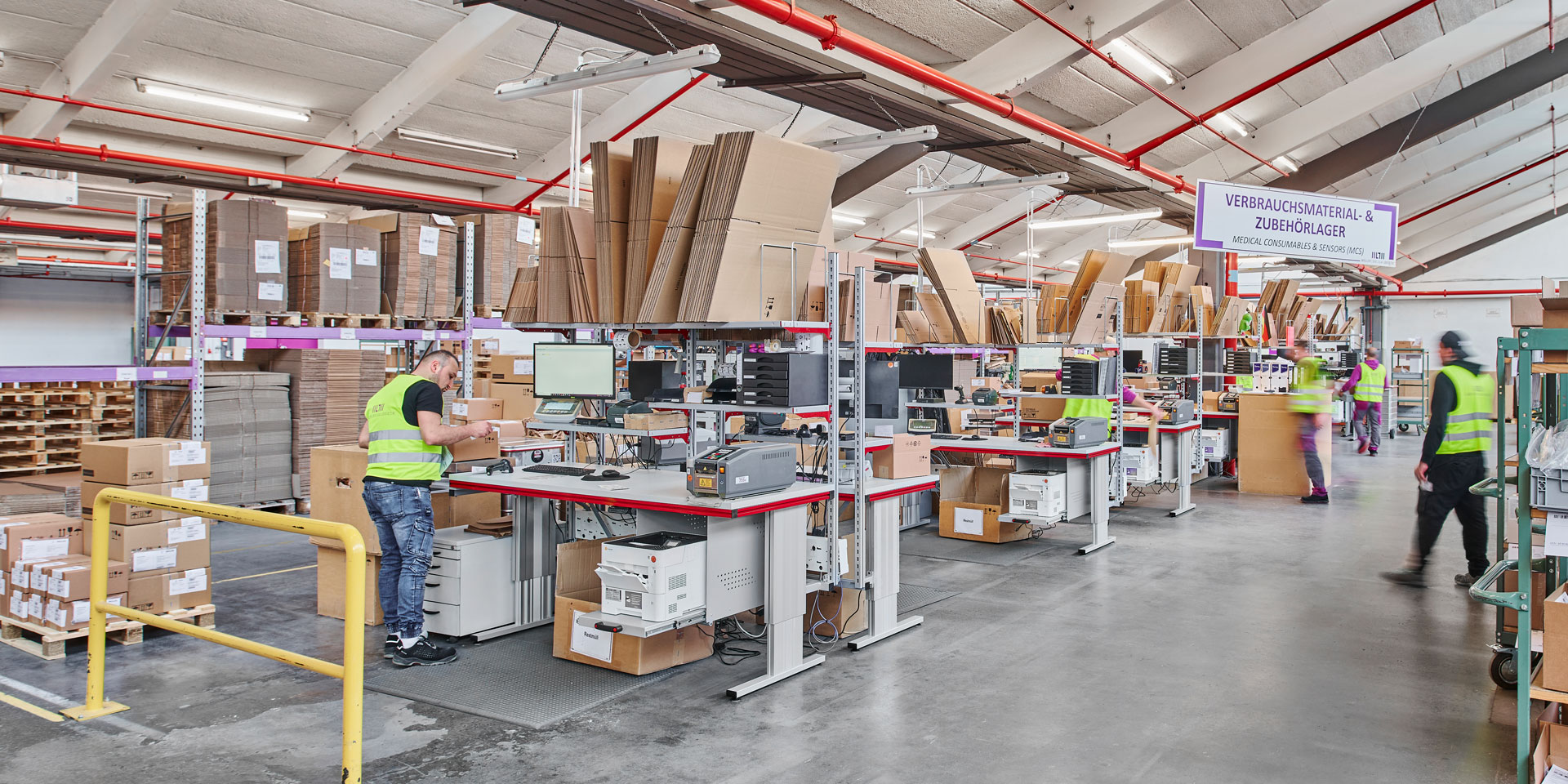
If you want to make your warehouse, dispatch or packing processes more efficient and ergonomic, we can support you with tailored packing tables and digital assistance systems. This enables you to optimise workstations in line with your needs and develop your logistics processes in a structured manner.
Get expert advice on logistics process optimisation
FAQ
How can you tell when logistics processes need to be optimised?
Typical indicators include recurring errors, long lead times, unnecessary distances, time-consuming searches or a decline in on-time delivery rates. Increasing physical strain at the workstation and significant variations in working methods amongst employees also point to a need for optimisation.
Which areas in logistics are most commonly subject to optimisation?
Optimisation most frequently relates to order picking, packing processes, material provision, goods receipt and internal transport routes. In these areas, process errors often have a direct impact on lead time, quality, costs and safety.
How much effort is involved in implementing logistics process optimisation measures?
The effort required depends on the objective, the size of the facility and the complexity of the processes. Many measures can be implemented in stages, for example by adapting individual workstations, standardising workflows or making targeted use of digital assistance systems.
How important is ergonomics for logistics process optimisation?
Ergonomics is an important factor because physically demanding workflows affect productivity, error rates and the long-term employability of employees. Ergonomically designed workstations help to improve movement and ensure that manual processes are carried out more consistently.
Which companies benefit most from logistics process optimisation?
Logistics process optimisation is particularly relevant for companies with high dispatch volumes, manual packing and order-picking processes, a wide range of product variants or increasing quality requirements. Even in the face of growing cost pressures and a shortage of skilled workers, structured optimisation quickly becomes economically significant.